There's a question every dating app has to answer before it does anything else: how do we make money?
The two dominant answers are well known. Tinder, Bumble, and Hinge make money from your attention — they show you ads, throttle the free experience, and sell you escape hatches you wouldn't need if the app worked properly in the first place. Most other dating apps make money from your data — your activity, your messaging patterns, the categories you keep returning to — packaged and sold to advertisers and data brokers, either directly or through "anonymized" intermediaries who routinely fail at anonymity.
There is a third option that almost nobody tries: charge users once, directly, for the thing that actually costs you money. Maybe is the third option.
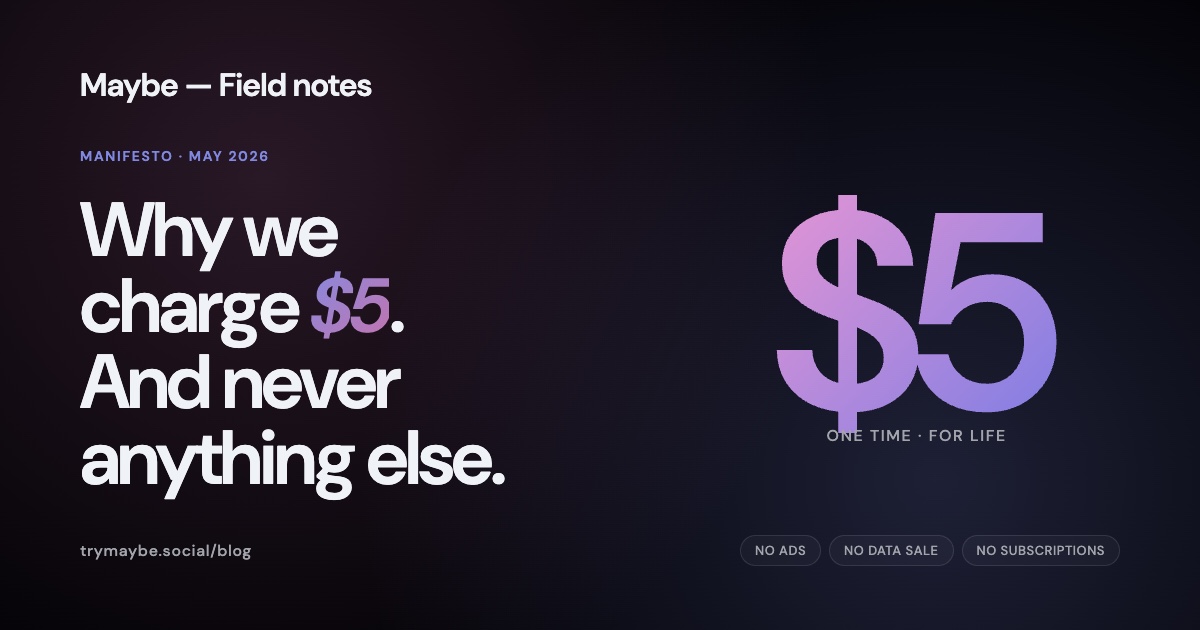
We charge $5. Once. Forever.
What $5 actually covers
The $5 fee isn't pricing — it's cost recovery. It pays for the things we genuinely need to spend money on to run a privacy-first dating app:
- Identity verification. Every signup goes through Stripe Identity, which charges us roughly $1.50 per user. This is the moat that keeps bots, scammers, and serial bad actors off the platform. Without it, the entire safety model falls apart.
- Mesh infrastructure. Our beachhead launch is a single venue. Running a Lambda + RDS stack at that scale costs pennies per user. As we expand, the per-user cost falls because mesh networking shifts compute to the phones, not the cloud.
- A small team building this honestly. Salaries, hosting, the unsexy stuff. We're solo-built and self-funded. We're not optimizing for billion-dollar exits. The $5 has to cover a sustainable, narrow-focus product team — not a 200-person growth org.
That's it. No hidden subsidization. No "we lose money on free users and recoup it on whales." Every user pays the same $5 once, and that fee covers the actual cost of having that user on the platform.
What we explicitly refuse to do
Some product decisions are easy because we've ruled out the temptation. Here is the list of things Maybe will never do:
- Show ads. Not banner ads. Not interstitial ads. Not "sponsored profiles." Not affiliate links to dating coaches. Nothing.
- Sell your data. Not to advertisers. Not to data brokers. Not to "research partners." Not to AI training pipelines. The data we collect — phone hash, photo embedding for block enforcement, ephemeral session IDs for mesh routing — never leaves our infrastructure, and most of it gets purged when you walk out of a venue.
- Run a premium tier. No Tinder Gold equivalent. No paid feature that quietly unlocks the thing the free tier was promising. The product you get for $5 is the entire product.
- Use an algorithmic feed. No "people we think you'd like." No engagement-maximizing reorder. The feed is the people physically in the room with you, full stop.
- Engineer for retention. No streaks. No "X people viewed your profile." No notification campaigns designed to drag you back. The product wants you to walk into a real room and put your phone down.
Why every other model corrodes the product
The reason we are this absolutist about the business model is that we've watched every alternative slowly destroy products we loved.
The ad-supported model
Every product decision skews toward "what keeps users staring at the screen." That is the exact opposite of "what helps users meet someone in real life." A dating app whose revenue depends on session time has a structural incentive to delay you from meeting anyone. Engagement and outcomes are at war, and engagement always wins — because engagement is what shows up in the next board deck.
The freemium model
The free tier degrades over time. New features ship to paid. Existing features quietly move to paid. The product you signed up for stops working as advertised, and the only way to restore it is monthly extraction. We've all watched this happen.
The data-broker model
Even when no ads show up in the app, your behavior is being aggregated, packaged, and sold. Your dating history becomes a commodity. Health insurers, employers, and political campaigns have all been identified as buyers of dating-app behavioral data. The fact that the app doesn't show ads doesn't mean nobody is profiting from your activity.
The venture-scale growth model
Venture investors expect 10x returns within a defined window. Once that pressure is in the cap table, every product decision becomes "what extracts the most value per user," not "what helps the user." It's not malice — it's math. A privacy-first product cannot survive the math of a Series A.
Maybe rejects all four because we want the incentives to be clean. The product designs itself when the only revenue is the cost of running the product.
Most social apps reward volume. Maybe rewards restraint.
The whole business model, on one line
User privacy is sacrosanct — and the only way we can keep that promise is by never needing your data to make money in the first place. The $5 fee is enough to keep bots out, cover identity checks, run a small mesh infrastructure, and pay a small team building this honestly.
That's it. That's the whole business model.
Every other dating app has a story to tell about why their monetization isn't really compromising their product. We don't have to tell that story. We just don't compromise.
A few honest questions about this
What if you raise the fee later?
Locked at $5 for life for waitlist users. Pricing changes will only apply to new signups, and the locked price will be communicated in the waitlist welcome email.
What if you take VC funding?
We're solo-built and self-funded for now. If we ever take outside investment, the no-ads, no-data-sale, $5-once model is non-negotiable. Any term sheet that compromises it gets refused.
What if $5 isn't enough?
Then we're a smaller product than we hoped. That's an acceptable outcome. We'd rather be a smaller honest product than a bigger compromised one.
What about subscriptions?
Different model, different incentives. We charge once because identity verification is the only thing that costs us money per user. Subscription models force us to invent reasons to charge you monthly. We'd rather not.