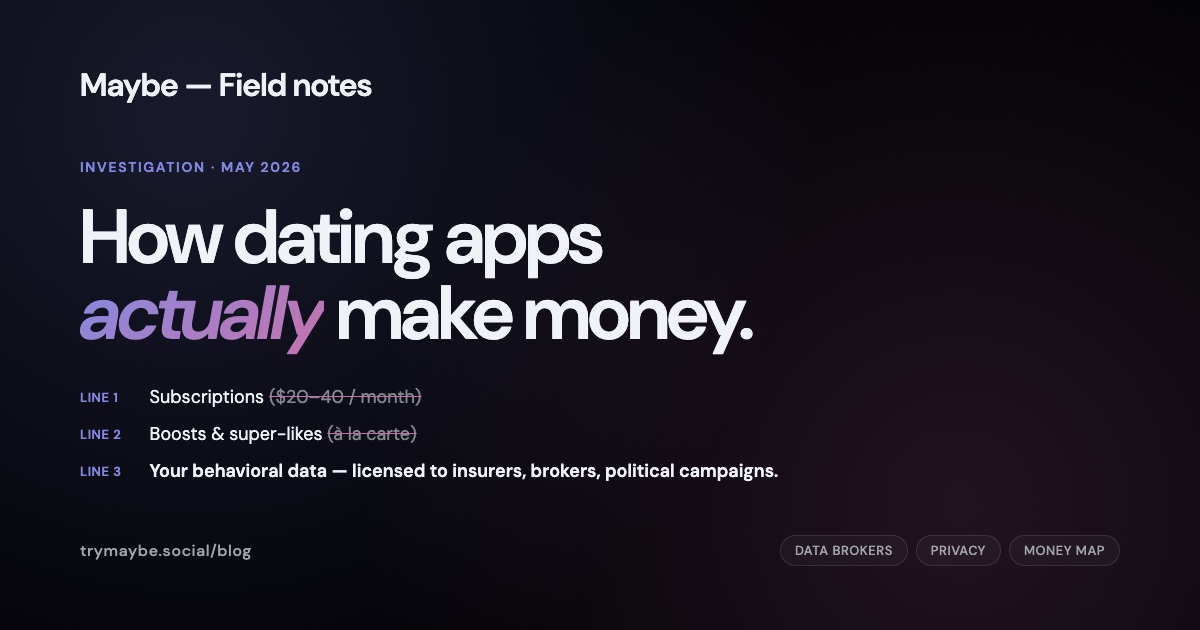
If you ask the average Tinder or Hinge user how the app makes money, the answer is usually "subscriptions, I guess?" If you press a little — what about boosts, super likes, ads? — they'll add those to the list. That's the visible revenue. It's also a fraction of the picture.
The full revenue picture for most major dating apps has three lines on it. The first two are above the fold. The third is the one users almost never hear about, and it's the one that actually shapes what the product becomes.
Line one: subscriptions
The headline product. Tinder Gold, Tinder Platinum, Hinge Preferred, Bumble Premium. Pay $20-40 a month and unlock features that the free version specifically nerfs: unlimited swipes, seeing who liked you, undoing accidental left-swipes, sending unprompted messages, prioritized placement.
This line is straightforward and well-disclosed. It's also the part of the business that has visibly stagnated for years. Subscription growth in dating apps has been flat or negative across most major brands since 2022. The companies talk about it on earnings calls; they keep adjusting the price and the feature mix; the curve doesn't bend.
Line two: à la carte
The micro-transactions. Boosts (your profile gets shown more for 30 minutes). Super Likes (a thing nobody asked for that costs real money each). Read receipts. Travel mode. Re-rolls. These are designed to extract additional revenue per user beyond the subscription, and they're priced like in-app-purchase mobile gaming — small enough to feel inconsequential, large enough that they add up.
The product design implications of this line are worse than the subscription line. Once a company is making meaningful revenue from boosts, every product decision about visibility starts to slant: who gets seen organically vs. who has to pay to be seen, how long matches "naturally" decay before requiring intervention, how often you're presented with a moment that you could fix with $4.99. The free user experience deteriorates by design, because that deterioration is the conversion funnel.
Line three: behavioral data
This is the one that doesn't show up on the home page of the app store listing. It's not a feature you pay for. It's not advertised, even within the app. It often isn't called out in the consumer-facing privacy policy in any specific way — it's wrapped in language about "service providers," "research partners," and "anonymized analytics." But it's a line item on the revenue side of every major dating app's P&L.
The data being licensed includes — depending on the app — some combination of:
- Demographics. Age, gender, location, declared sexual orientation, declared interests, occupation, education, declared political and religious affiliation.
- Location history. Where the app has been opened, at what address, at what time, for how long. Across months. With enough granularity to identify a user's home, work, gym, favorite bar.
- Swipe taxonomy. Not just who you swiped right on, but the categorical patterns. Right-swipes are clustered into demographic and visual profiles that turn into behavioral fingerprints — "this user is interested in left-handed brunettes with master's degrees" — that travel with the dataset.
- Messaging metadata. Who you matched with, how fast you responded, how long the conversation went, whether it terminated abruptly. Conversation content is usually not included (most apps haven't ever sold the message text), but the pattern of messaging is.
- Inferred attributes. The model that ingests the above produces tags the user never declared: probable orientation, probable income bracket, probable mental health flags (long messaging gaps + heavy app usage at night gets flagged), probable substance use, probable political leaning.
The buyers, depending on the app and the year, have included:
- Data brokers — Acxiom, Oracle's data marketplace, Epsilon, and dozens of smaller aggregators who repackage and resell.
- Insurance underwriters — health and life insurance companies that use the data to refine actuarial models (and, separately, to inform individual underwriting in the markets that don't outlaw it).
- Political consultancies — for ad targeting and turnout modeling. Some of the most-discussed political microtargeting case studies of the last decade traced back, in part, to dating-app data brokers.
- Employer screening services — companies that ingest behavioral graph data to "verify" candidates against undisclosed criteria.
- Government agencies — through subpoena, through procurement, and (less ethically) through the data-broker market, which sells to anyone with the money.
The "we don't sell your data" sleight of hand
Most dating apps' privacy pages contain the phrase "we do not sell your personal information" or some close variant. Read literally, that statement is sometimes true. The industry has converged on contractual structures where the data isn't sold in the strict legal sense — it's licensed, shared with partners, analyzed by service providers, or transmitted via "data clean rooms" where the buyer gets analytical output without raw rows.
The economic effect is identical. The buyer pays. The dating app receives money. The data leaves the dating app's systems and becomes useful to a third party. The verb is the only thing that changes.
End-to-end encryption protects the message. Mesh networking protects the existence of the message. The business model decides whether either matters.
Why this corrodes the product
A dating app whose third revenue line is your behavioral data has a structural incentive to maximize the behavioral data collection. Every UX decision flows downstream from that incentive. Questions during onboarding that nobody needs to know but that enrich the profile. Default-on location tracking that the safety justification can't fully account for. Feed ordering that surfaces a wider spread of profiles than the user asked for (so the right-swipe signal hits more categorical buckets). Friction on deletion. Reminder notifications that drag inactive users back so the data stays fresh.
None of these decisions are necessarily made by people who think of themselves as collecting and selling data. They're made because the metric that goes up — engagement, profile richness, retention — happens to be the metric the data buyer pays for. The motive is hidden in plain sight inside the analytics dashboard the product team optimizes against.
What honest monetization would look like
Charge users the actual cost of running the product. Make sure the cost is small enough that the price isn't extractive — small enough that users barely notice — and then refuse every other revenue line that introduces a conflict of interest with the user's actual goals.
This is what Maybe does. We charge $5 once, which covers identity verification plus the cost of running the infrastructure. No subscription. No boosts. No "premium tier." No data licensing of any kind. The data we collect literally never leaves our systems, and most of it is engineered to expire when you walk out of a venue (see the mesh-networking architecture).
This is a smaller business than the alternatives. It will probably never produce a billion-dollar exit. That's fine — most users don't actually want a billion-dollar dating app. They want one that works.
You can tell which incentive a dating app is optimizing for by looking at its money. Maybe is optimized for the user being in the same room as someone they want to meet, because that's the only thing we sell.